

Why does memorising hundreds of service names often leave candidates feeling unsettled when they finally face the CLF-C02 exam? It’s a common frustration amongst those preparing for the AWS Certified Cloud Practitioner qualification, where the gap between knowing a definition and applying it to a business scenario can feel vast. If you feel overwhelmed by the technical volume or anxious about the high-stakes nature of the test, you aren't alone. Integrating structured AWS Cloud Practitioner practice exams into your routine is the most effective way to bridge this gap, turning confusing jargon into clear, actionable knowledge.
We understand that true preparation requires more than just flashcards; it requires a calm and disciplined approach to how AWS services solve real-world business problems. This guide provides a composed, step-by-step path to help you master the 2026 exam requirements and secure a passing score of at least 700. You will discover how to navigate complex scenario-based questions and build the genuine confidence required to succeed on your first attempt. We will examine the four critical exam domains, whilst offering plain-English strategies to organise your study time and eliminate the fear of the unknown on exam day.
Key Takeaways
- Understand how the CLF-C02 exam weighting has shifted in 2026 to prioritise security and shared responsibility across the cloud environment.
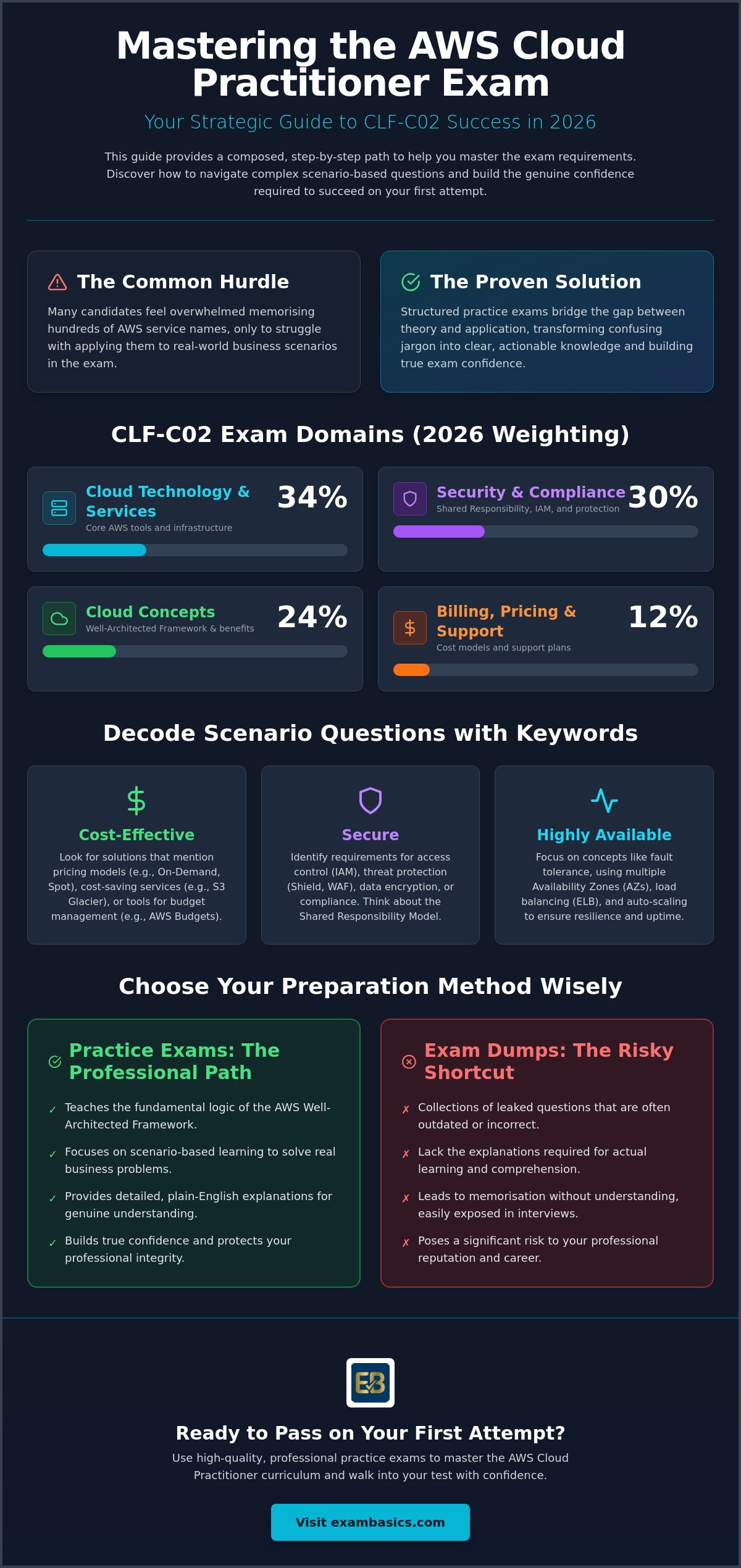
- Master the "Keywords" strategy to quickly identify whether a scenario-based question is asking for a cost-effective, secure, or highly available solution.
- Use professional AWS Cloud Practitioner practice exams to transition from memorising service names to understanding how they solve practical business challenges.
- Implement a methodical two-week study routine that builds from basic infrastructure to advanced security models and billing structures.
- Develop the mental clarity needed for exam day by focusing on clear, jargon-free explanations that bridge the gap between theory and practice.
What are AWS Cloud Practitioner Practice Exams and Why Are They Vital?
High-quality AWS Cloud Practitioner practice exams serve as a mirror for your current level of readiness. In 2026, the CLF-C02 version of the exam requires a shift in mindset from simple memorisation to analytical application. Whilst earlier versions of the certification focused heavily on service definitions, the current iteration demands that you understand how the broad suite of Amazon Web Services tools creates value for a business. Relying on an independent, vendor-neutral practice tool allows for an objective assessment of your progress without the bias of marketing-led training materials. It's about organising your thoughts to match the logic of the cloud, rather than just recalling facts.
The Purpose of a Practice Simulator
A professional simulator does more than just present questions; it recreates the psychological environment of the actual 90-minute test. Facing 65 multiple-choice or multiple-response questions requires mental stamina that many candidates underestimate. By practising in a controlled, calm environment, you can learn to manage your time effectively whilst navigating the vast landscape of over 200 services. These simulations help you identify specific knowledge gaps amongst the four key domains. This ensures you don't waste time reviewing concepts you've already mastered, allowing for a more efficient and focused study routine. It builds the confidence necessary to face the screen on exam day without panic.
Practice Exams vs. Exam Dumps: A Matter of Integrity
It's tempting to seek shortcuts, but "exam dumps" pose a significant risk to your professional reputation and your long-term career growth. These collections of leaked questions often contain incorrect answers and lack the detailed, plain-English explanations required for genuine learning. High-integrity AWS Cloud Practitioner practice exams focus on scenario-based learning that teaches you the fundamental logic of the AWS Well-Architected Framework. This disciplined approach ensures you don't just pass the exam; you also perform confidently during technical discussions and job interviews. Employers can quickly distinguish between someone who has memorised answers and someone who truly understands how cloud technology solves business problems. Quality preparation is an investment in your professional future.
Understanding the CLF-C02 Exam Domains for 2026
The CLF-C02 exam is structured into four distinct domains, each requiring a specific depth of understanding. According to the official CLF-C02 exam guide, the weightings are as follows: Cloud Concepts (24%), Security and Compliance (30%), Cloud Technology and Services (34%), and Billing, Pricing, and Support (12%). This distribution highlights a significant focus on security and technology, which together constitute over 60% of the marks. Organising your study notes to mirror this structure ensures you allocate your time proportionally. High-quality AWS Cloud Practitioner practice exams are particularly useful here, as they help you verify your grasp of each domain's specific weightings. It's often best to treat Cloud Concepts as your foundation, whilst moving towards the more technical aspects once you understand the underlying philosophy of the cloud.
Domain 1 & 2: Cloud Concepts and Security
Mastering the AWS Shared Responsibility Model is your first priority here. You must clearly distinguish between what AWS manages, such as the physical security of the data centre, and what the customer manages, like guest operating systems and firewall configurations. This logic extends to the six pillars of the AWS Well-Architected Framework: Operational Excellence, Security, Reliability, Performance Efficiency, Cost Optimisation, and Sustainability. For the security domain, focus on how services like IAM (Identity and Access Management) control permissions, whilst Shield and WAF (Web Application Firewall) protect against external threats. Understanding these relationships is a core part of succeeding in AWS Cloud Practitioner practice exams, as questions often test your ability to assign responsibility correctly in a business scenario.
Domain 3 & 4: Technology and Billing
Domain 3 covers the actual tools you will use. You should be able to compare core services such as EC2 for compute, S3 for storage, and Lambda for serverless functions. It is less about technical configuration and more about knowing which service fits a specific business use case. Domain 4 shifts to the financial side, requiring knowledge of AWS Billing and Pricing. You'll need to understand how Cost Explorer helps you visualise spending and how Trusted Advisor provides recommendations for cost optimisation. Differentiating between support plans is also vital; you must know that Enterprise support includes a Technical Account Manager (TAM), whilst the Business tier offers 24/7 access to engineers. To refine your understanding of these specific service categories, you might consider using AWS Cloud Practitioner practice resources to identify which plan best suits different organisational needs.
How to Decode Scenario-Based Questions
Decoding the CLF-C02 exam requires you to look past technical jargon to see the underlying business need. Many candidates struggle because they treat the test as a vocabulary quiz rather than a test of professional judgement. High-quality AWS Cloud Practitioner practice exams prepare you for this by presenting scenarios that mirror the day-to-day responsibilities of what an AWS Cloud Practitioner does. Instead of asking what a service is, the exam asks which service best solves a specific problem under certain constraints. Success depends on your ability to remain composed whilst dissecting the question to find the "Keywords" that point to the correct answer. You must remember that the most technically advanced solution isn't always the right one if it doesn't align with the specific goals mentioned in the prompt.
Anatomy of an AWS Scenario
Every scenario typically follows a three-part structure: the Setup, the Constraint, and the Goal. The Setup introduces a hypothetical company or workload. The Constraint adds a limitation, such as "with the lowest possible cost" or "without managing servers". Finally, the Goal defines the desired outcome. You must be wary of "distractors", which are real AWS services that perform the correct function but fail to meet the specific constraint provided. For instance, a question might ask for a scalable database; whilst RDS and DynamoDB both scale, only one might be "serverless". In the context of practitioner exams, the correct answer is almost always the one that prioritises cost-optimisation whilst meeting the basic functional requirement.
Developing a Disciplined Thinking Process
A disciplined approach moves you away from intuitive guessing towards logical deduction. When using AWS Cloud Practitioner practice exams, don't just celebrate a correct answer. You should be able to state exactly why the other three options are incorrect. Reading the full explanation for every question, even those you get right, is vital for building this mental framework. It ensures you haven't arrived at the right conclusion through a misunderstanding. Exambasics promotes this methodical rhythm, helping you build the stamina to eliminate wrong options systematically. This process of elimination reduces anxiety and ensures that on exam day, your choices are based on a clear understanding of the AWS Well-Architected Framework logic.
A Step-by-Step Study Plan for Exam Success
Passing the CLF-C02 isn't about endurance; it's about consistency. Whilst some online forums suggest "cramming" the material in 48 hours, this approach often leads to high anxiety and poor long-term retention. A disciplined four-week plan allows you to absorb complex concepts without feeling overwhelmed. By following a structured rhythm, you can move from a basic understanding of cloud terminology to a position of genuine professional confidence.
- Week 1: Foundations and Global Infrastructure. Focus on the physical layout of AWS. Understand the difference between Regions, Availability Zones, and Edge Locations. This is the bedrock of the entire platform.
- Week 2: Core Services and Security Models. Perform a deep dive into compute, storage, and database services. Revisit the Shared Responsibility Model mentioned earlier to ensure you know exactly where the customer's duties begin.
- Week 3: Initial Practice Attempts. Start using AWS Cloud Practitioner practice exams in a non-timed environment. Your goal here is to identify weak areas amongst the four domains and refine your notes based on the explanations provided for incorrect answers.
- Week 4: Timed Simulators and Final Confidence Building. Transition to full-length, 90-minute simulations. This week is about building the mental stamina required for 65 questions whilst maintaining a steady pace.
Creating a Focused Study Environment
Quality of study always trumps quantity. Thirty minutes of deep, uninterrupted work is far more effective than three hours of distracted browsing. Organise your physical space to be free from distractions. A tidy environment helps reduce testing anxiety and allows your mind to focus on the logical structure of the AWS Well-Architected Framework. Tracking your progress through a simple checklist can provide a sense of achievement that maintains your motivation throughout the month.
Using Timed Practice Mode Effectively
Moving from "study mode" to "timed exam mode" is a critical milestone in your preparation. Timed AWS Cloud Practitioner practice exams help you analyse your test-taking behaviour. Are you rushing through the Setup of a scenario, or are you overthinking the distractor answers? Use these simulations as feedback loops. If you consistently struggle with Billing and Pricing questions, dedicate your next deep-work session specifically to that domain. This methodical refinement ensures there are no surprises on the actual exam day.
To begin your structured preparation with high-quality, scenario-based questions, explore our AWS Certified Cloud Practitioner (CLF-C02) practice materials designed for professional advancement.
Why Choose Exambasics for Your AWS Practitioner Prep?
Selecting the right study partner is a decision that impacts your mental clarity as much as your final score. Unlike static PDF resources that offer little more than a list of questions, our AWS Cloud Practitioner practice exams are built on a dynamic platform designed for the serious professional. We prioritise a calm, distraction-free interface that allows you to focus entirely on the logic of the cloud. By maintaining a vendor-neutral stance, we provide an unbiased assessment of your readiness. This ensures you're prepared for the nuances of the actual CLF-C02 exam rather than just marketing-led training material.
Our commitment to integrity means every scenario-based question is original and accompanied by clear, jargon-free explanations. We don't just tell you which answer is correct; we explain the underlying business logic that makes it so. This approach builds genuine understanding, which is far more valuable than rote memorisation when you're sitting in the testing centre. It transforms the preparation process from a source of stress into a disciplined routine for professional growth. You'll find that our methodical rhythm helps lower anxiety, making the path to certification feel manageable and structured.
Features Designed for Learner Clarity
Detailed progress tracking is integrated into the platform to help you visualise your journey towards success. You can see exactly how your performance improves across the four key domains, allowing you to allocate your study time with precision. Our timed modes are specifically calibrated to mirror the official Pearson VUE experience, helping you build the necessary stamina for the 90-minute session. Because we value your long-term career path, our catalogue of AWS Cloud Practitioner practice exams is part of a broader suite of resources. This includes preparation for the AWS Certified Developer - Associate (DVA-C02) and other professional-level certifications as your expertise grows.
Start Your Journey Today
You can begin by accessing our free practice attempts to establish a baseline for your current knowledge. This low-pressure introduction allows you to experience our focused atmosphere before committing to more comprehensive preparation. For those ready to secure their certification with absolute certainty, our premium bundles offer a complete suite of scenario-based tools. A disciplined study routine is the most reliable path to success, and we act as your steady, knowledgeable partner throughout that process. Quality preparation is an investment in your career, providing the tools you need to succeed on your first attempt.
Prepare for your AWS Certified Cloud Practitioner exam with Exambasics.
Achieving Professional Clarity in the Cloud
Securing the CLF-C02 certification requires a transition from simple recall to the practical application of the AWS Well-Architected Framework logic. By following a structured study plan and mastering the specific domain weightings for 2026, you can replace testing anxiety with professional composure. High-quality AWS Cloud Practitioner practice exams are the most effective tool for this transition, as they allow you to identify knowledge gaps whilst building the mental stamina needed for the actual session. It's about organising your thinking to match the logic of the cloud.
We've designed our platform to offer scenario-based questions that mirror the 2026 exam logic, ensuring your preparation is both relevant and rigorous. Every answer includes a detailed explanation to build your confidence and resolve any lingering confusion, whilst our timed practice modes reduce the pressure of exam day. You've already taken the first step by understanding the requirements; now it's time to put that knowledge into practice with a disciplined approach.
Master the CLF-C02 with Exambasics Practice Exams
Your journey towards professional advancement is a steady process of improvement. With a calm mindset and the right tools, you'll be well-prepared to succeed on your first attempt.
Frequently Asked Questions
How many questions are on the AWS Cloud Practitioner exam in 2026?
The AWS Certified Cloud Practitioner (CLF-C02) exam consists of 65 questions. These are presented in either multiple-choice or multiple-response formats. Whilst 50 of these questions contribute to your final score, 15 are unscored questions used by AWS for data collection. You are allocated 90 minutes to complete the session, which requires a steady and methodical pace of roughly 80 seconds per question to ensure you have time to review your answers.
Is the AWS Cloud Practitioner exam difficult for someone with no IT experience?
This certification is specifically designed for individuals in non-technical roles, such as sales, marketing, or project management. It requires an understanding of cloud foundations rather than deep technical configuration. Candidates with no prior IT background often find success by using structured AWS Cloud Practitioner practice exams to bridge the gap between abstract terminology and practical business scenarios. Success depends on your ability to grasp the logic of the cloud rather than memorising code.
Can I pass the CLF-C02 exam by using only practice questions?
Passing the exam requires a balance of conceptual study and active testing. Relying solely on practice questions might leave you unprepared for the specific scenario variations found in the actual test. It's more effective to use these questions to identify knowledge gaps and then refer back to the AWS Well-Architected Framework to deepen your understanding. This disciplined approach ensures you can handle any scenario by understanding the underlying principles of the cloud.
What is the passing score for the AWS Practitioner exam?
The passing score for the CLF-C02 exam is 700 on a scaled score ranging from 100 to 1,000. Because AWS uses a scaled scoring model, the number of correct answers needed can vary slightly depending on the difficulty of the specific questions you receive. Achieving a consistent score of 80% or higher on professional simulators is a reliable indicator that you are ready to face the exam with confidence and mental clarity.
How long should I study for the AWS Cloud Practitioner certification?
Most candidates find that 20 to 30 hours of dedicated study, spread over three to four weeks, provides a comfortable rhythm for success. This timeframe allows you to absorb the four key domains without the pressure of cramming. A structured plan involving daily 30-minute sessions is often more effective for long-term retention than infrequent, long study periods. This methodical approach helps you build a genuine understanding of how AWS services solve organisational problems.
What happens if I fail the AWS exam on my first attempt?
If you don't pass on your first attempt, AWS requires a 14-day waiting period before you can schedule a retake. You can attempt the exam as many times as necessary, though you must pay the full exam fee for each subsequent session. This interval is an excellent opportunity to use AWS Cloud Practitioner practice exams to target the specific domains where your score was lower, ensuring you are better prepared for your next attempt.
Are these practice exams updated for the latest AWS services?
High-quality practice materials are regularly updated to align with the current CLF-C02 content outline and the latest AWS service releases. The 2026 version of the exam places a heavier emphasis on security, shared responsibility, and sustainability than previous iterations. Ensuring your study tools reflect these changes is vital for an accurate assessment of your readiness. These updates help you stay current with the architectural best practices that AWS expects from a certified professional.
What is the difference between the CLF-C01 and the CLF-C02 exam?
The CLF-C02 is the current version of the certification, having replaced the retired CLF-C01. The primary difference lies in the updated domain weightings, with a significant increase in the focus on Security and Technology. These two areas now constitute 64% of the total score. The newer version also introduces more complex, scenario-based questions that require you to identify the most cost-effective or efficient service for a specific business use case, rather than just defining the service.